
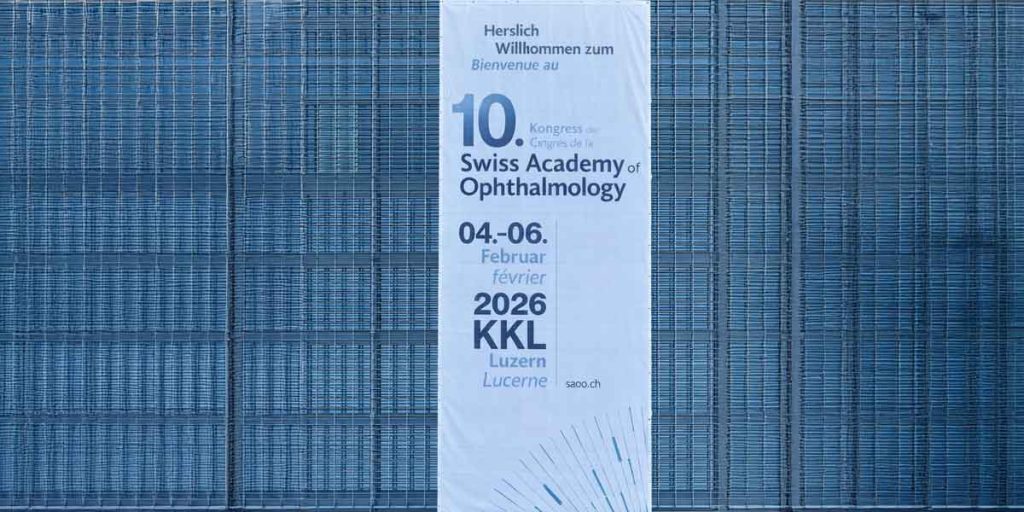
For decades, keratoplasty defined the end stage of keratoconus management. At the 10th Congress of the Swiss Academy of Ophthalmology (SAoO), held at the KKL Luzern, that assumption was examined critically—and with some discomfort. The question posed was deliberately direct: will keratoplasty for keratoconus still be needed in 2040?
This question framed a scientific presentation by ELZA corneal, cataract, and refractive surgeon, Emilio Torres-Netto, MD, PhD, FEBO, FWCRS. Rather than arguing for the disappearance of transplantation, the lecture explored how its role has already begun to contract and specialize as earlier, less invasive interventions have matured. Will Keratoplasty for Keratoconus Still Be Needed in 2040? Historically, penetrating and later lamellar keratoplasty were unavoidable for many patients with progressive ectasia.

Over the past two decades, however, the clinical trajectory of keratoconus has changed. Earlier diagnosis through advanced tomography, widespread adoption of CXL, and the increasing use of corneal regularization strategies have shifted intervention to much earlier stages of disease. As a result, fewer patients now progress to the level of corneal failure that once made transplantation inevitable.
In his SAoO presentation, Dr. Torres-Netto reviewed these developments through the lens of long-term clinical outcomes. He emphasized that while keratoplasty has become less frequent, it has not become redundant. Advanced scarring, late presentation, biomechanical collapse, and contact lens intolerance continue to define a subgroup of patients for whom transplantation remains appropriate. What has changed is the context: keratoplasty is increasingly a selective intervention rather than a default endpoint.
The lecture also addressed how lamellar techniques and tissue-sparing approaches have refined surgical indications and outcomes when transplantation is required. In parallel, the expanding repertoire of non-transplant interventions has raised a more nuanced question – not whether keratoplasty will disappear, but how rarely it may be needed if disease progression is identified and stabilized early enough.

Within the broader framework of the SAoO congress, which this year celebrated its tenth edition with a clinically focused and forward-looking program, the presentation served as a reminder that progress in keratoconus management has been incremental, evidence-driven, and cumulative. By 2040, keratoplasty is likely to remain part of the therapeutic landscape – but for fewer patients, and for clearer reasons than ever before.